
In general, loyalty schemes in the poker industry are broken. They tend to reward players who are already incentivised, and they do little to console players who lose money. As a trial, Full Tilt wanted to create a 'progressive jackpot' game -- that is, a small side game in which a cash prize is incremented every time a poker hand is played.
My responsibility was to lead the design of the game, including the core gameplay, and to deliver completed designs and specifications to our in-house development teams.
We needed to design a game that was simple and intuitive, yet had enough complexity and volatility to keep players engaged. As the game was targeted at poker players (who often had a cynical view of lottery games), we felt the game should be based around playing cards and poker hands. As a first step, we opened a few decks of cards, sat at a table and started making up games.
Based on our knowledge of board games and on our understanding of the psychology of gaming (including partial reinforcement schedules), we identified a number of possible options, and we proceeded to create small interactive prototypes in Flash to demonstrate to senior stakeholders. After a number of changes to the core loop gameplay and the volatility of payouts, we began to focus on the overall UI of the mini-game and the gameplay experience.

The mini-game, which became known as The Deal, was presented to players as a stand-alone side game, on both desktop and mobile platforms. To participate in the mini-game, players had to earn a 'coin' by playing at real money poker tables.
Some players might earn a coin once every few weeks, while other players would earn several a day.
This presented us with a difficult situation where some players might only play once a week, and others might wish to play 20 times at a single sitting.
Both the game complexity and the UI for the buy-in screen had to accommodate these distinct behaviours.

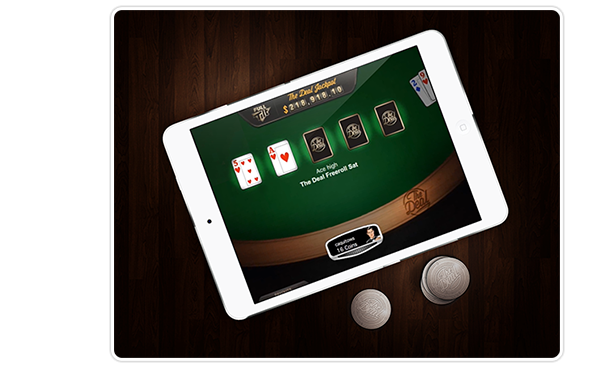
After buying into the game, players are dealt 7 cards from a deck. The cards are dealt face down. The UI prompts the player to select 2 cards, which are shown to the player, and then discarded to the side of the screen. The remaining 5 cards are turned over one-by-one to make a 5 card poker hand.
The strength of the hand determines the value of the prizes, with any player turning over a Royal Flush winning a shot at the full Jackpot prize. Crucially, the 2 discarded cards remain to the side of the screen so players can easily see what they could have won if they'd made a different choice.
This decision, driven by my team, was crucial to the success of the game.
I led the design team behind the distinctive identity for The Deal game. The logo - a stylised rendering of the words 'The Deal' onto a silver coin - was used on all promotional graphics and 1,000 silver coins were minted and sent to poker journalists to generate publicity in anticipation of the launch.
The Deal surpassed even the most optimistic estimates for success, and was acclaimed across the industry for its innovative approach to player reward mechanisms.
On its first day, there was a surge in the number of unique players across Full Tilt's tables and over 480,000 hands of the new mini-game were played.
The entire concept - including the UI, gameplay and promotional artwork - was adapted by PokerStars in 2016 and continues to be a success.

